Full course syllabus

Every module, in full.

Stop collecting prompt tricks. Build the mental models to understand how AI actually works—then design, evaluate and use AI systems with confidence.

Built for technical thinkers No advanced math required Tool-agnostic by design
Context Tools Evals Memory
MODEL
9durable mental models
5–6hfocused core learning
9applied exercises
1AI system capstone

The gap

You use AI.
But do you understand it?

Most AI education teaches the interface: which tool to click, which prompt to copy, which feature launched this week. ExplAIn teaches the system underneath—knowledge that stays useful when the tools change.

01 / THE BUZZWORDS

RAG, agents, memory and context blur together.

You know the words. You need the map that connects them.

02 / THE BLACK BOX

The model feels intelligent—until it fails.

You need to predict where probability helps and where it creates risk.

03 / THE DEMO TRAP

A clever prototype is not a reliable system.

You need the language of architecture, controls, evaluation and trade-offs.

The transformation

From AI builder to AI owner.

By the end, you won’t just know more terminology. You’ll be able to reason about AI systems, challenge architecture decisions and make better ones yourself.

01
Explain what the model is doingDescribe tokens, context, training and inference without hand-waving.
02
See the complete systemSeparate the model from the product, data, memory, tools and infrastructure.
03
Choose the right mechanismKnow when to use context, retrieval, memory, fine-tuning or external systems.
04
Use agents intentionallyRecognize where autonomy creates value—and where it creates failure modes.
05
Design for reliabilityIdentify what may stay probabilistic and what must be controlled or verified.
06
Evaluate beyond the demoMeasure quality, latency, cost, regressions and real-world failure patterns.

The core syllabus

Nine models.
One complete map.

Each module answers one essential question, introduces one durable mental model and ends with an applied decision—not a memory test. Open any module to explore it.

00
The map

What is an AI system?

+

“The model generates. The system does.”

Build the full map before diving into the individual parts.

AI vs ML vs GenAILLMsModel vs productTraining vs inferenceAPIs & databases
Applied exercise: Dissect ChatGPT, a coding assistant and a support bot into model, context, tools, state and external systems.

Open the full module →

01
Inside the model

How a model sees the world

+

“Context is the model’s working reality.”

Learn enough transformer architecture to explain real model behavior—without turning this into a math lecture.

TokensEmbeddingsTransformersAttentionContext windowsContext dilutionToken cost
Applied exercise: Predict which of three differently structured contexts will produce the strongest answer—and explain why.

Open the full module →

02
Learning

How models learn

+

“Training changes the model. Inference uses it.”

Replace the “giant database” misconception with a useful model of training, behavior and knowledge.

PretrainingNext-token predictionParametersGeneralizationFine-tuningPost-trainingKnowledge cutoffs
Applied exercise: Classify which actions change model parameters, context, memory or application state.

Open the full module →

03
Probability

Reasoning, sampling and hallucination

+

“Fluency is not the same as truth.”

Understand why models can be impressive and wrong at exactly the same time.

Token probabilitiesSamplingTemperatureNon-determinismHallucinationReasoning modelsTest-time compute
Applied exercise: Decide where probability is acceptable in six product scenarios and where verification must be deterministic.

Open the full module →

04
Context

Context engineering

+

“Construct the world the model reasons inside.”

Move beyond prompt tricks into deliberate construction of the model’s working environment.

System instructionsUser instructionsHistoryFew-shot examplesStructured outputsContext orderingPrompt injection
Applied exercise: Redesign an overloaded assistant context with conflicting instructions, irrelevant history and poor retrieval.

Open the full module →

05
Knowledge

Retrieval, memory and fine-tuning

+

“Information, state and behavior are different problems.”

Untangle the concepts that are most often mixed together.

Semantic searchVector similarityChunkingRAGGroundingApplication memoryFine-tuning decisions
Applied exercise: Choose prompt, retrieval, memory, database, fine-tuning—or a combination—for five product scenarios.

Open the full module →

06
Tools

How models interact with the real world

+

“The model requests. Another system acts.”

Understand tool use without treating APIs, function calling or MCP as magic.

Function callingStructured toolsAPIsWeb searchCode executionDatabasesPermissionsMCP
Applied exercise: Design the tool surface of a travel assistant and decide which capabilities should never be exposed directly.

Open the full module →

07
Agents

Agents without the mythology

+

“An agent is a loop with model-selected decisions.”

Separate workflows from autonomy—and learn why more agentic is not automatically better.

Workflow vs agentPlanningObservation & actionStateAgent loopsHuman approvalMulti-agent systemsFailure propagation
Applied exercise: Redesign four use cases as workflows, partially agentic systems and autonomous agents, then compare risk.

Open the full module →

08
Evals

Building AI you can trust

+

“A demo is not a system.”

Move from “it worked for me” to measurable production thinking.

Evaluation datasetsGolden setsHuman evaluationLLM-as-a-judgeDeterministic checksFailure taxonomyRegression testingCost & latency
Applied exercise: Compare two architectures where one performs better but is substantially slower and more expensive. Decide what belongs in production.

Open the full module →

How you’ll learn

Built for clarity.
Designed to stick.

Short, visual and applied. Every format earns its place: diagrams for systems, audio for durable concepts and exercises for the decisions you’ll face in real work.

▶

Visual lessons

Short explanations built around diagrams—not hour-long talking heads.

◇

Visual notes

System maps and decision frameworks you can return to after the course.

◉

Audio editions

Podcast-style explanations for concepts that survive without a screen.

↗

Applied exercises

Predict behavior, debug architecture and choose trade-offs. Minimal memorization.

The capstone

Dissect a real AI product.

Create an AI System Map that explains the architecture clearly enough to expose trade-offs, risks and failure points. You won’t just finish with knowledge—you’ll finish with a way of thinking.

01What is the model doing?
02What enters context?
03Where does knowledge come from?
04Where does state live?
05Which tools can act?
06What is probabilistic?
07What must be deterministic?
08How do we know it works?

Is it for you?

Technical depth.
Human language.

ExplAIn sits between superficial tool tutorials and academic machine-learning courses. It’s designed for people who need a strong conceptual foundation they can actually use.

This course is for you if…

  • You’re a software engineer, data professional, technical PM, founder or engineering leader.
  • You already use AI, but the concepts still feel fragmented or overly abstract.
  • You want to design, evaluate or lead AI work—not just operate a chat interface.
  • You prefer durable understanding over weekly lists of “the hottest tools.”

It’s not built for…

  • People looking only for ready-made prompts.
  • A full mathematical derivation of transformer architecture.
  • A certification based on passive watching.
  • A course tied to one model, vendor or interface.

When you finish

A certificate you earned.

Issued when the capstone is done—not for watching videos.
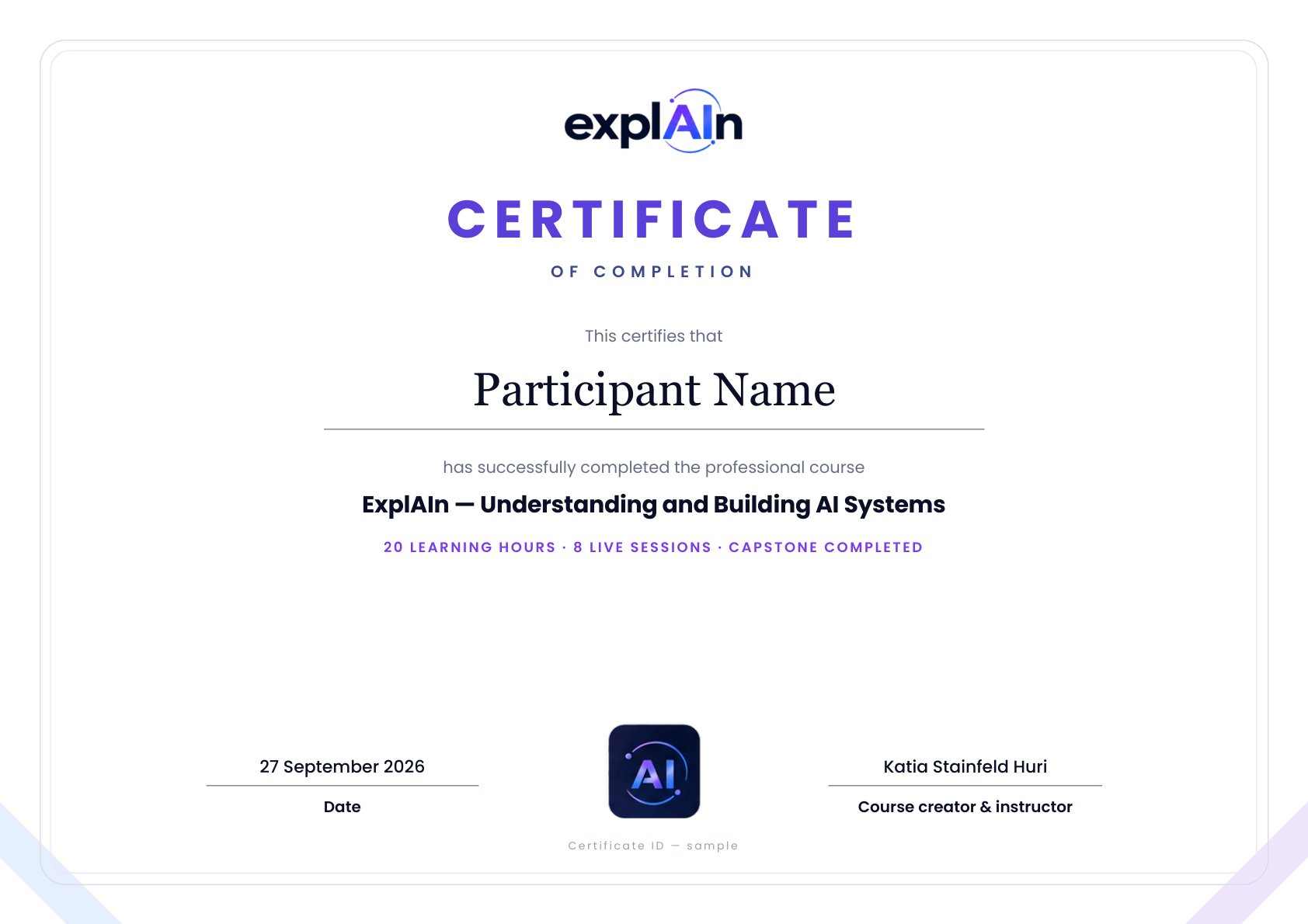
  • 20 learning hours across nine modules
  • Capstone AI System Map completed
  • Unique ID on every certificate
ExplAIn certificate of completion: the participant's name, the course title, 20 learning hours, 8 live sessions, capstone completed, the date, Katia Stainfeld Huri's signature and a unique certificate ID.